
Eye Health Guides · Children's Myopia
Why does my child's short-sightedness keep getting worse?
Short-sightedness in children usually keeps changing because the eyeball itself is still growing. Here is what drives it, and what can be done.
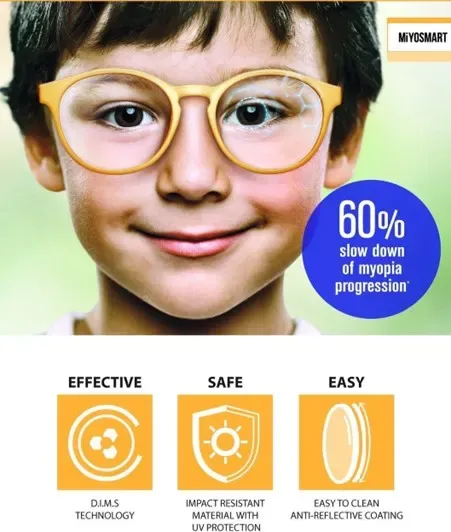
If your child needs a stronger prescription almost every time you visit the optician, that is not bad luck and it is not your child “needing new glasses again.” It is a sign that the eyeball itself is still growing, and growing in a way that pushes the point of focus further out of reach.
What is actually happening inside the eye
Short-sightedness, or myopia, happens when the eyeball grows slightly too long from front to back. Light entering the eye focuses just in front of the retina instead of directly on it, so distant objects look blurry while close-up vision usually stays clear.
In adults, the eye has stopped growing, so the prescription is generally stable. In children, the eye is still developing, which is exactly why the prescription keeps changing. Each check-up captures a slightly longer eyeball than the last.
Why some children’s eyes grow faster than others
Genetics play a role: children with one or both parents who are short-sighted are more likely to be short-sighted themselves, often more severely. But researchers also point to two environmental factors that appear to accelerate the process:
- More near work. Extended reading, homework and screen use all involve focusing at close range for long periods.
- Less time outdoors. Time spent outdoors in natural daylight is consistently linked to slower eye growth in children, independent of near work habits.
Malaysia’s rates of childhood myopia are among the highest in the region, which fits this pattern: urban childhoods with more screen time and less unstructured outdoor play.
The difference between correcting vision and managing myopia
A new pair of glasses corrects the blur so your child can see clearly today. It does not do anything to slow how much the eyeball grows over the next year. That is the specific gap myopia management is built to close: not a stronger prescription, but an approach that measurably slows the rate of change itself.
If your child’s prescription has changed at each of their last two or three visits, that pattern alone is usually a good reason to have a proper myopia assessment rather than just updating the glasses again.
Clinical sources and further reading
Good to know
Some change is common while a child is growing, but a prescription that keeps rising noticeably, year after year, is exactly what myopia management is designed to address. It is worth an assessment rather than just a stronger pair of glasses each time.
Myopia progression typically slows and stabilises in the late teens as eye growth finishes, but for some children it continues into their twenties. Managing progression during childhood is about limiting how much the eye grows before that natural slowdown happens.
No. Wearing the correct prescription does not speed up myopia progression. What ordinary single-vision glasses do not do is slow the progression down, which is the specific gap that myopia management addresses.
Questions are easier answered in person.
Book an eye check and we will talk it through properly.