
Eye Health Guides · Comparing Myopia Treatments
Ortho-K vs atropine vs myopia control lenses: which is right for your child?
There is no single best option. Ortho-K, low-dose atropine and myopia control lenses each work differently, and are often combined based on your child's age, lifestyle and how fast their myopia is progressing.
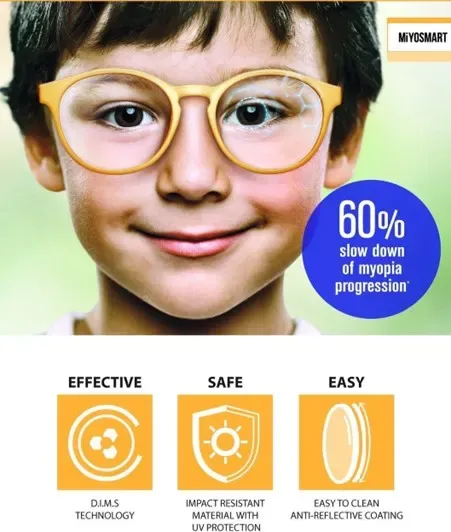
If you have started researching childhood myopia management, you have probably run into three names repeatedly: Ortho-K, atropine eye drops, and myopia control spectacle lenses. Each one genuinely works, each one works differently, and none of them is automatically “the best” for every child.
The short version
- Ortho-K reshapes the cornea overnight so your child sees clearly during the day without glasses or contacts.
- Myopia control spectacle lenses look and wear like ordinary glasses, but are optically designed to slow eye growth.
- Low-dose atropine is a nightly eye drop that acts on the biological signal driving eye growth, often used alongside one of the other two.
The table below compares them directly.
How we actually choose
After a full assessment, your child’s optometrist will recommend an option, or a combination, based on their age, how quickly their prescription is changing, and practical questions like whether they are comfortable with contact lens hygiene, or whether a daily eye drop routine is realistic for your family.
Whichever option you start with, the process does not stop there. Progress is measured at scheduled re-checks, typically every six months, so you can see whether it is working rather than taking anyone’s word for it.
Clinical sources and further reading
| Ortho-K (overnight lenses) | Myopia control spectacle lenses | Low-dose atropine eye drops | |
|---|---|---|---|
| What it is | Custom rigid contact lenses worn overnight that reshape the cornea | Spectacle lenses with a special optical design (such as Hoya MiYOSMART, Essilor Stellest or Zeiss MyoCare) | A diluted eye drop, used nightly, that acts on the eye's growth signal |
| Day-to-day experience | No glasses or contacts needed during the day | Worn like ordinary glasses, all day | One drop at night; glasses or contacts still needed for daytime vision |
| Typical published efficacy | Roughly 30 to 56 percent slower axial growth versus no treatment | Roughly 60 to 70 percent slower progression versus single-vision lenses, depending on the lens | Meaningful reduction in progression at the 0.05 percent concentration in published trials |
| Well suited to | Active children, sports, children who prefer not to wear glasses or contacts during the day | Children who are not ready for contact lenses, or want the simplest daily routine | Often combined with lenses or Ortho-K for an extra effect, or where lenses alone are not enough |
| Worth knowing | Requires consistent overnight wear and proper lens hygiene | Effect depends on wearing the lenses consistently, ideally full-time | Some children experience light sensitivity or need reading support at higher doses |
Good to know
Yes. It is common to combine low-dose atropine with either Ortho-K or myopia control lenses for an additional effect, particularly when a child's myopia is progressing quickly.
None of them work instantly. All three are measured over months, with re-checks typically every six months to see whether progression is slowing as expected.
No single option is best for every child. The right choice depends on age, lifestyle, how fast the myopia is progressing, and what the family can manage day to day. We recommend the best fit after a full assessment, not a one-size-fits-all package.
All three are established, widely used approaches to myopia management, prescribed and monitored by qualified optometrists. As with any treatment, they are not appropriate for every child, which is why an assessment comes first.
Questions are easier answered in person.
Book an eye check and we will talk it through properly.